Moving house checklist: what to do 30 days before, the week of and on the day
Published on October 14, 2026
Moving is a project with a fixed deadline, lots of small tasks and several people involved. What causes the most stress is not carrying boxes, but finding out at the last minute that nobody turned off the power, told the bank or booked the elevator. A checklist split by deadline takes that weight off your memory.
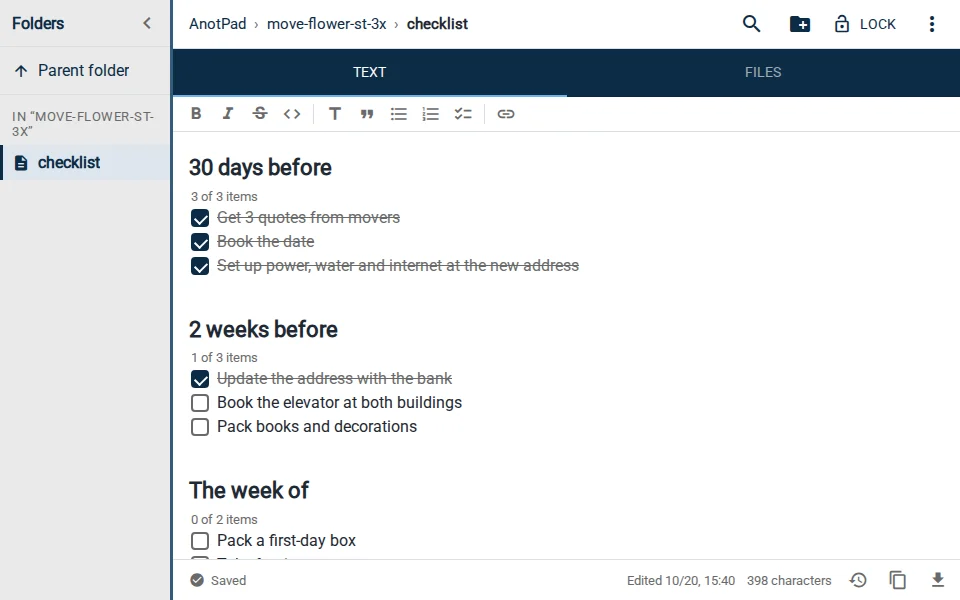
Set up the structure before you start
Create a folder for the move with a few separate notes. That way, whoever is packing does not have to scroll through the list of accounts to transfer to find what to do:
| Note | What for |
|---|---|
move-flower-st-3x/checklist | Tasks by deadline (the content of this guide) |
move-flower-st-3x/boxes | What is in each numbered box |
move-flower-st-3x/contacts | Movers, building manager, electrician, landlord |
move-flower-st-3x/shopping | What to buy for the new place |
Send the folder link to everyone who is helping. Everyone edits the same notes, changes show up in real time and nobody needs to ask "did anyone do this yet?".
30 days before
- Get quotes from at least three moving companies and book the date.
- Sort out what will be donated, sold or thrown away. The less stuff, the cheaper and faster the move.
- Measure the rooms in the new place and check that large furniture fits through the doors.
- Request the transfer or connection of electricity, water, gas and internet at the new address.
- Gather boxes, tape, bubble wrap and markers.
Two weeks before
- Update your address with the bank, your employer, the kids’ school and online stores.
- Notify the building management at both places and book the service elevator, if there is one.
- Start packing what you barely use: books, decorations, off-season clothes.
- Use up what is in the pantry and freezer, so you move less food.
The week of the move
- Pack almost everything, leaving out only the essentials for the last days.
- Set aside a "first-day box": documents, medicine, chargers, toilet paper, towels, a change of clothes, snacks and basic tools.
- Take apart the furniture that needs it and keep the screws in small bags taped to the piece itself.
- Confirm the time with the movers and the building manager.
- Defrost and clean the fridge the day before.
On the day
- Photograph the electricity and water meter readings at the old place and the new one.
- Check every room, closet and drawer before handing over the keys.
- At the new place, show where each box goes, by the room written on it.
- Set up the beds first. After a moving day, nobody wants to assemble a bed at midnight.
Photos of the meters, and of any furniture damaged in transit, can go in the Files tab of the checklist note. Images are shrunk automatically and stay next to the date and your notes.
Numbered boxes: the system that saves you from hunting for the can opener for three days
Number every box and write on it only the number and the destination room (for example, "14 - kitchen"). In the boxes note, one line per box says what is inside: "14 kitchen: pots, can opener, colander". At the new place, when you need something, open the note and use your browser’s find (Ctrl+F) to locate the item and go straight to the right box.
This system also helps you check that everything arrived: at the end of the day, count the boxes and compare with the last number on the list.
After the move
Use the shopping note for what the new place is missing (curtains, light bulbs, brackets) and the contacts note for maintenance services. Once everything is settled, delete the moving notes from the ⋮ menu, or keep only the contacts one, which tends to stay useful longer.
Do not keep ID numbers, account passwords or bank details used to transfer services in your notes.
Start from a ready-made template
Read also
- I deleted my text by mistake: how to recover it and avoid it next timeWhat to try first, how to use version history and habits that prevent the scare.
- How to choose note names nobody can guess (and you will not forget)Why the name is the note’s key, and a simple recipe for safe names.
- How to write drafts without getting stuck: a four-step methodDump, organize, write and revise: each step in its own time.