Class notes: how to organize them by subject and review for exams
Published on October 14, 2026
Writing down everything the teacher says is not studying; it is copying. The notes that help on exam day are short, organized and reviewed soon after class. This guide shows one way to get there without spending more time than you already do.
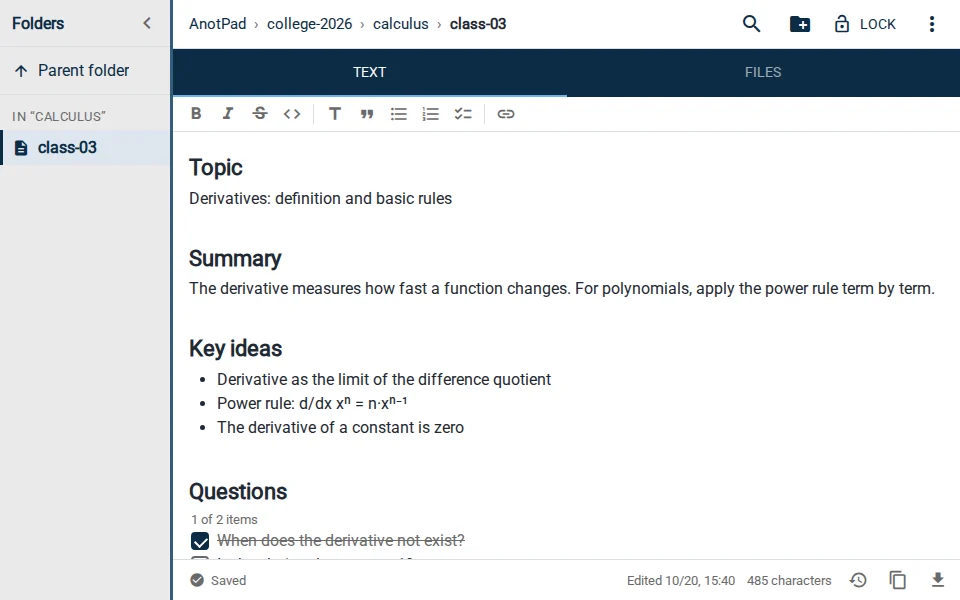
One folder per subject, one note per class
The structure that works for most courses has three levels: the term, the subject and the class. With notes by address, that simply becomes the note’s name:
| Address | What it holds |
|---|---|
college-2026-fall/calculus/class-01 | Notes from the first Calculus class |
college-2026-fall/calculus/problem-sets | Exercises and questions from the problem sets |
college-2026-fall/calculus/exam-1 | Final summary for the first exam |
college-2026-fall/history/class-01 | Notes from the first History class |
college-2026-fall/deadlines | Exam, assignment and project dates for every subject |
Number classes with two digits (class-01, class-02... class-10) so they stay in order in the side panel. At the end of the term, the whole folder becomes an archive of what you studied.
What to write down during class
Instead of transcribing, look for three things: what the teacher repeated, what they wrote on the board and what they said "will be on the exam". You will find the rest in the book or the slides.
A simple template for each class note:
- TOPIC: one line with the subject of the class.
- KEY IDEAS: three to five short points, in your own words.
- EXAMPLES: the example solved on the board, or a pointer to it (slide 12).
- QUESTIONS: what you did not understand, to ask or look up.
- FOR THE EXAM: what the teacher highlighted.
If the teacher shows a chart or a formula that is hard to type, take a photo of the board and attach it in the note’s Files tab. Images are shrunk automatically, so they fit within the 2 MB per-file limit.
The 15-minute same-day review
The part that makes the biggest difference happens after class. The same day, ideally in the evening, open the note and do three things:
- Finish the half-written sentences while you still remember the context.
- At the top of the note, write a two- or three-sentence summary as if explaining it to a classmate who missed the class.
- Turn the key ideas into questions (for example, "what is a derivative?") and put them at the end of the note.
Those questions are your exam review. During exam week, instead of rereading everything, try to answer the questions without looking and only go back to the text when you get stuck. This kind of active recall usually sticks much better than rereading.
Studying in a group
A note by address also works for splitting the work with classmates. Create one shared note per subject, like study-group-k8/exam-1-summary, and each person writes their part. Changes show up in real time, and the history keeps the last 2 versions in case someone deletes a section by mistake.
To send the final summary to the class without anyone changing it, use "Copy read-only link" in the ⋮ menu. Keep in mind it is only a view: whoever removes the end of the address can edit, so keep a copy.
The deadlines note
One note with every date of the term avoids surprises. Use one line per date, in year-month-day format, so everything stays in order: "2026-11-04 Calculus: exam 1 (up to derivatives)". So you do not forget, create a reminder from the note (⋮ menu › Create reminder), which puts the alert in your Google Calendar, Outlook or Apple Calendar with the note’s link.
Common mistakes
- One single note for the whole subject, which grows into a huge text that is impossible to review.
- Copying the slides instead of writing down what the teacher explained about them.
- Leaving the review for the night before the exam, when the notes no longer make sense.
- Keeping personal data, like your student ID and portal password, next to your notes.
In short
A folder per subject, a note per class, a fixed template and a short review on the same day. It sounds like little, but it is what separates a notebook you never open again from material that actually helps on exam day.
Start from a ready-made template
Read also
- How to write simple meeting notes (with a ready-to-copy template)A lean template and what to write before, during and after the meeting.
- How to capture ideas quickly before they vanish: the inbox note methodOne note to drop everything into right away, and a weekly review to give each item a home.
- How to plan a trip with notes: itinerary, budget, bookings and packingFive notes that cover everything from the itinerary to packing, and how to use them on the road.